What is living in Edgewood, NM like?
Living in Edgewood means open land, room to grow, and a genuinely convenient location right between Albuquerque and Santa Fe. Once a small homesteading community along Route 66, Edgewood has become one of New Mexico’s fastest-growing towns, now serving as the retail and service hub for the entire East Mountains and Estancia Valley region.
Why Living in Edgewood Appeals to Buyers Who Want Room to Grow
Edgewood’s motto, “Where the Mountains Meet the Plains,” captures the town well. Homes here often sit on larger lots than you’ll find closer to Albuquerque, with open views stretching across the Estancia Valley and the Sandia Mountains rising to the west. It’s grown fast, but it hasn’t lost the small-town, rural character that keeps drawing new residents in.
For buyers who want space, a straightforward commute, and a town with real momentum behind it, Edgewood has become one of the more compelling options east of Albuquerque.
From Homestead Land to New Mexico’s Newest Boomtown
Edgewood’s growth story is one of the more dramatic in the region, and it’s still unfolding.
Homesteaders, Route 66 & the Road to Incorporation
In the early 1900s, homesteaders took advantage of federal land claim laws to settle the area, farming and ranching across the open Estancia Valley. The community grew slowly along the 1937 alignment of Route 66, but it wasn’t until local residents and landowners pushed for self-governance that Edgewood formally incorporated as a town on July 1, 1999. According to the Town of Edgewood’s official history, the town started with roughly 1,800 residents and has grown to about 6,300 in the years since, one of the fastest growth rates of any town in New Mexico.
A Town That Spans Three Counties
Edgewood sits primarily in Santa Fe County, but a series of annexations over the years extended its town limits into neighboring Bernalillo and Torrance counties as well, an unusual setup for a New Mexico municipality. Despite technically belonging to Santa Fe County, Edgewood sits much closer to Albuquerque than to the city of Santa Fe.
What a Tri-County Town Means for Buyers
If you’re buying property in Edgewood, it’s worth confirming exactly which county your parcel falls in, since that can affect property tax rates, permitting, and which local offices handle your paperwork. A good local agent can walk you through the specifics for any given address.
Homes, Land & Everyday Life in Edgewood
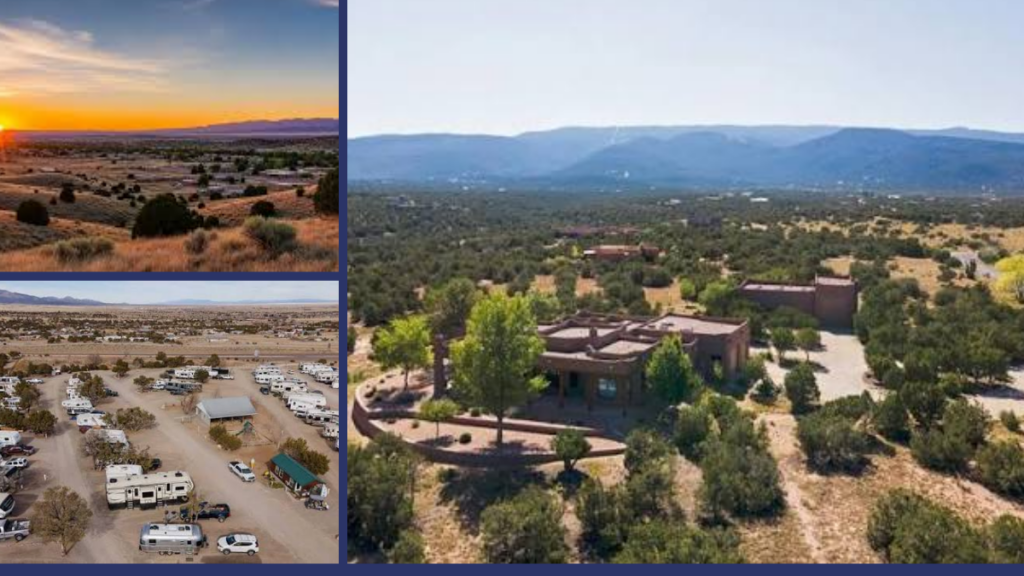
Edgewood real estate tends to favor larger lots and more land per dollar than comparable properties closer to Albuquerque, with a mix of newer subdivisions and older ranch-style properties spread across the open valley. Equestrian and hobby-farm properties are common here too, reflecting the area’s homesteading roots. Our Edgewood real estate listings page is a good place to see what’s currently available.
The Regional Hub of the East Mountains and Estancia Valley
As the town has grown, so has its role as a service center for the wider region. Edgewood now functions as the primary retail, dining, and healthcare hub for a broader East Mountain and Estancia Valley population of roughly 60,000 people, according to the town’s own community profile, meaning residents don’t have to drive all the way into Albuquerque for everyday errands and services.
Schools and Commuting
Unlike Tijeras, Cedar Crest, or Sandia Park, Edgewood is served by Moriarty-Edgewood Consolidated Schools rather than Albuquerque Public Schools, giving it its own distinct district covering the broader Estancia Valley area.
What Living in Edgewood Means for Your Commute
Edgewood sits along Interstate 40, with most commutes into Albuquerque running roughly 25 to 35 minutes depending on which part of town you’re leaving from and where in the city you’re headed. It’s a longer drive than the closer-in East Mountain communities, but many residents find the added space and lower housing costs make it worthwhile.
Frequently Asked Questions About Living in Edgewood
Edgewood is primarily located in Santa Fe County, though its town limits also extend into neighboring Bernalillo and Torrance counties due to a series of annexations over the years.
Edgewood formally incorporated as a town on July 1, 1999, growing from roughly 1,800 residents at the time to about 6,300 today.
Most commutes from Edgewood into Albuquerque run about 25 to 35 minutes via Interstate 40, depending on traffic and your specific starting and ending points.
Edgewood is served by Moriarty-Edgewood Consolidated Schools, a separate district from Albuquerque Public Schools, covering the broader Estancia Valley region
Yes. Edgewood is one of New Mexico’s fastest-growing towns, with its population expanding from around 1,900 people in 2000 to more than 6,000 today.
Edgewood real estate tends to feature larger lots than areas closer to Albuquerque, with a mix of newer subdivisions, ranch-style properties, and equestrian or hobby-farm land reflecting the area’s homesteading history.
Although Edgewood is technically part of Santa Fe County, it sits significantly closer to Albuquerque than to the city of Santa Fe, making it a practical option for Albuquerque commuters.
The Bottom Line
Living in Edgewood means open land, a genuine sense of small-town momentum, and a practical commute into Albuquerque, all in a town that’s grown into the true hub of the East Mountains and Estancia Valley. For buyers who want space without giving up nearby services, it’s one of the strongest growth stories in the region.We are Jennifer and Vinay Rodgers with The Rodgers Neighborhood Real Estate Group, powered by Real Broker, LLC. As Albuquerque area real estate agents with 12+ years of experience across Albuquerque, Rio Rancho, Corrales, Placitas, Los Ranchos, Bernalillo, Cedar Crest, Sandia Park, Tijeras, Edgewood, and the surrounding communities, we’re glad to help you see if Edgewood is the right fit. Reach us at 505-514-5356 or 505-417-2733.

Leave a Reply