What is living in the North Valley actually like?
Living in the North Valley means centuries-old acequias still running behind your fence line, cottonwood bosque instead of a backyard fence on some streets, and neighborhoods that were their own independent Spanish colonial villages long before Albuquerque annexed them. Unlike Corrales or Los Ranchos, which broke off and incorporated as their own towns, the North Valley’s old villages became part of the city itself, and you can still feel the difference block by block.
Why Living in the North Valley Feels Different From the Rest of Albuquerque
Most of Albuquerque was platted by developers working off a grid. The North Valley wasn’t. Its street patterns follow old field boundaries and acequia lines laid out by Spanish colonial farming families in the 1700s, which is exactly why the roads here curve, narrow, and dead-end in ways that confuse first-time visitors and make total sense once you understand what they were originally built around.
We’ve written before about Los Ranchos, one of the villages that managed to stay independent. The North Valley is the other half of that same story, the villages that didn’t.
The Valley That Split Three Ways
By the 1790 Spanish census, six distinct settlements strung along the Rio Grande north of Old Town: Los Candelarias, Los Griegos, Los Duranes, Los Gallegos, Los Ranchos, and Alameda, each built around the landholdings of a founding family. As Albuquerque grew through the twentieth century, those villages split into three different fates. Corrales and Los Ranchos incorporated on their own and kept independent local governments. Alameda was eventually annexed too. And Los Candelarias, Los Griegos, and Los Duranes were absorbed directly into the city of Albuquerque, losing their separate governments but keeping their names, their acequias, and a lot of their original character.
Los Duranes: A Plaza Bisected by the Interstate
Los Duranes was founded around 1750 by the Duran family along El Camino Real, the royal road connecting Santa Fe to Chihuahua, and the 1790 census counted 27 families living around its plaza. According to the National Register of Historic Places nomination for the district, Interstate 40’s construction in the late 1950s cut directly through the old plaza community, permanently splitting a neighborhood that had stayed physically whole for two centuries. It’s a genuinely striking piece of local history that most drivers speed past without any idea it’s there.
Los Griegos: A National Historic District Hiding in Plain Sight
Los Griegos, running roughly from Griegos Road south to Candelaria Boulevard, was formally designated a National Historic District in 1984. The 1790 census counted 109 residents across 25 households here, and the neighborhood was long known for its Easter penitente processions. Centuries-old buildings, working acequias, and streets still named after the area’s founding families remain today, tucked quietly between busier, more anonymous stretches of the city most people associate with Albuquerque instead.
What Happened to the Villages That Didn’t Incorporate
Losing independent village status wasn’t purely a loss. Annexation brought city utilities, police and fire coverage, and paved roads decades before some unincorporated communities got them. The trade-off was local political control, decisions about zoning and development in Los Duranes and Los Griegos today go through Albuquerque’s city government rather than a village council of their own.
Acequias, Long Lots & the Bosque
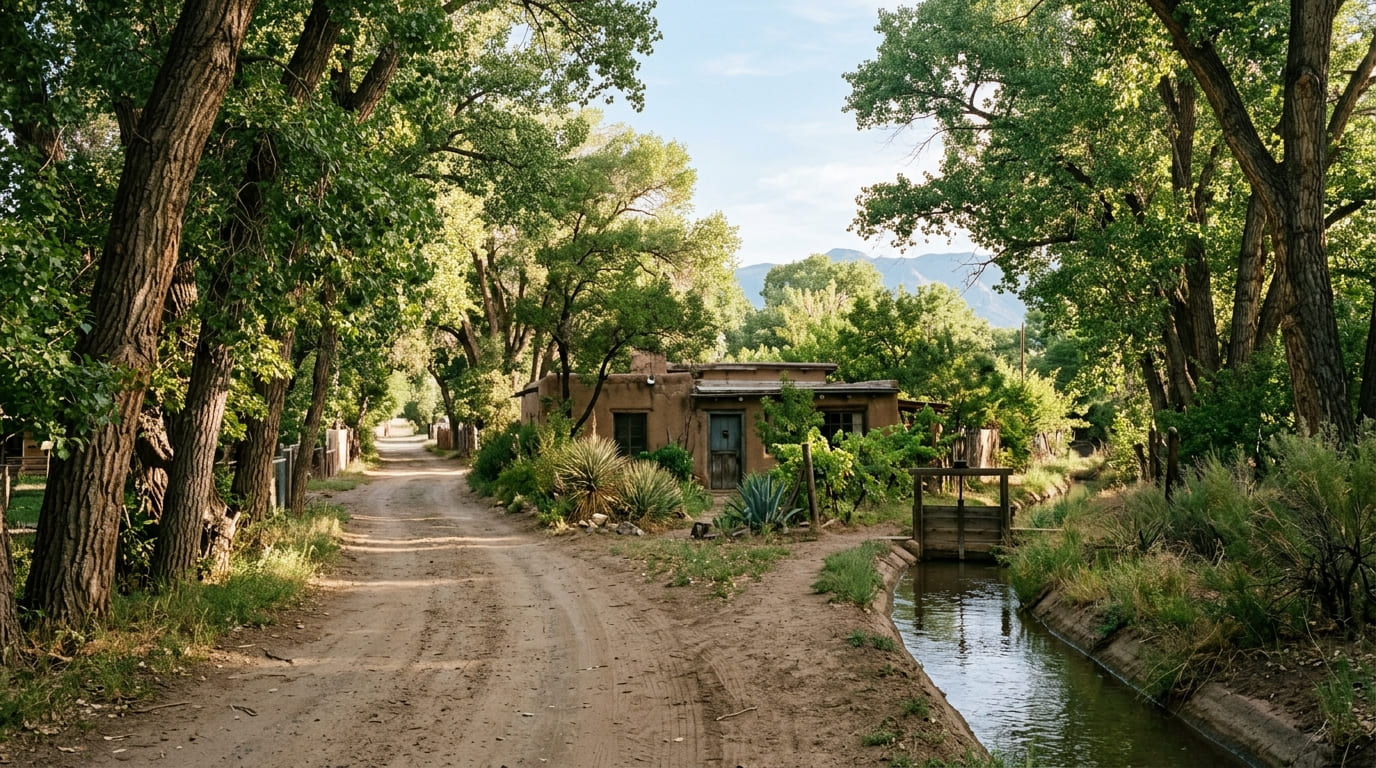
The same acequia madre irrigation network and narrow, river-facing lineas we’ve described in our Los Ranchos guide run through the North Valley too, since it’s genuinely the same historic farming culture, just under different municipal boundaries today. According to the Albuquerque Historical Society, many North Valley properties are still irrigated using the same acequia methods established by the original colonists, despite groundwater sitting just a few feet below the surface. The Rio Grande bosque, a dense cottonwood forest running the length of the valley, buffers many streets from the sound and sightlines of the surrounding city in a way no planned development can really replicate.
Homes and Everyday Life
North Valley Albuquerque real estate tends toward older custom homes on larger, often irregularly shaped lots, a direct legacy of the original linea land divisions. Because much of the area was annexed rather than newly built, homes here range widely in age and style, from modest mid-century houses to substantial custom estates along Rio Grande Boulevard. Our North Valley homes for sale page is a good starting point for seeing what’s currently available across the area.
Schools and Getting Around
The North Valley is served by Albuquerque Public Schools, the same district covering most of the surrounding city, rather than a separate village district like Los Ranchos or Corrales technically fall outside of.
What Living in the North Valley Means for Your Commute
Because the North Valley sits close to Old Town and central Albuquerque, most commutes downtown or to the university area run 10 to 20 minutes, among the shorter drives of any neighborhood with this much land and rural character. Fourth Street, one of the city’s oldest auto routes, still threads north through the valley much as it has since the early 1900s.
Frequently Asked Questions About Living in the North Valley
Mostly, yes. Unlike Corrales and Los Ranchos, which incorporated as separate villages, much of the North Valley, including Los Duranes and Los Griegos, was annexed directly into the city of Albuquerque.
Both areas share the same historic Spanish colonial farming roots along the Rio Grande, but Los Ranchos incorporated as its own independent village, while North Valley communities like Los Griegos and Los Duranes were absorbed into Albuquerque’s city government.
Most date to the 1750s, with Los Duranes and other family-founded settlements appearing in a Spanish census as early as 1790, making them among the oldest continuously settled areas in the Albuquerque metro.
Yes. Many North Valley properties still use the historic acequia irrigation network first built by Spanish colonial farmers, and acequia rights and maintenance responsibilities can come attached to specific parcels.
The North Valley is served by Albuquerque Public Schools, the same district that covers most of the surrounding city.
Yes. Los Griegos was designated a National Historic District in 1984, recognized for its centuries-old buildings, working acequias, and continuous settlement history dating to the 1700s.
Most of the North Valley sits within a 10 to 20 minute drive of downtown and Old Town, making it one of the more centrally located areas of the metro with this much land and rural character.
Living in the North Valley means owning a piece of the same 300-year-old farming culture that shaped Corrales and Los Ranchos, just inside Albuquerque’s city limits instead of a separate village’s. For buyers who want land, history, and a short commute all in the same package, it’s genuinely one of the more distinctive corners of the metro. We are Jennifer and Vinay Rodgers with The Rodgers Neighborhood Real Estate Group, powered by Real Broker, LLC. Our North Valley listing specialists understand acequia rights, historic district rules, and irregular lot lines well enough to walk you through them clearly. Reach us at 505-514-5356 or 505-417-2733.

Leave a Reply