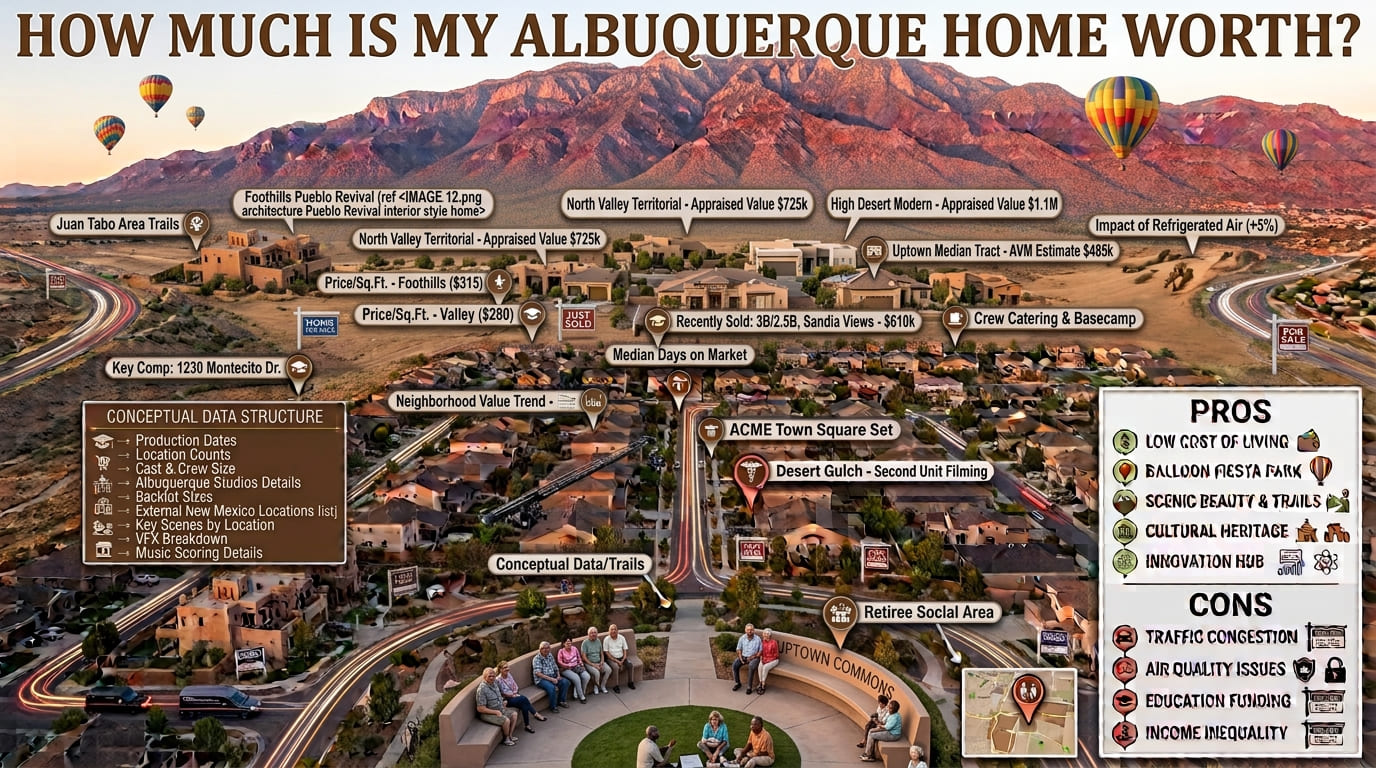
The honest, slightly annoying answer: probably not what that number on Zillow says, and in Albuquerque specifically, the gap tends to run wider than the national average.
Online home value tools are genuinely useful for a rough ballpark, but they’re built on public sales data, and New Mexico happens to be one of the harder states in the country for that kind of tool to work well in. That’s not a knock on the technology, it’s a quirk of New Mexico property law most homeowners have never heard of.
How Much Is My Albuquerque Home Actually Worth Right Now?
The real answer depends on recent comparable sales in your specific neighborhood, your home’s condition and updates, and current buyer demand, none of which an algorithm can fully see from the outside. A trustworthy number takes all of that into account together, not just square footage and a public records lookup.
Why Online Estimates Struggle Specifically in New Mexico
Automated valuation tools aren’t scams, they’re just working with less information than most homeowners assume, and New Mexico makes that problem worse.
Zillow’s Own Numbers Show the Margin of Error
Zillow itself publishes its Zestimate’s median error rate, and it’s not small: roughly 2% for homes currently listed for sale, but closer to 7% for homes that aren’t on the market. On a $400,000 home, a 7% miss is $28,000 in either direction. That’s Zillow’s own disclosed number, not a competitor’s criticism, and it varies significantly by city depending on how much reliable public data is available in that market.
New Mexico’s Non-Disclosure Law Makes It Worse Here
Here’s the part specific to us: New Mexico is a non-disclosure state, meaning actual sale prices aren’t automatically recorded in public records the way they are in states like California or Texas. Enforced in part through rules overseen by the New Mexico Real Estate Commission, this system protects buyer and seller privacy, but it also means automated valuation tools have less reliable raw data to work with here than in most other states, they end up filling gaps with estimates, tax assessments, and older listing data instead of confirmed sale prices.
What This Means for Your Zestimate Specifically
In practice, it means the algorithm behind your online estimate is working with a thinner, less certain dataset than it would in a disclosure state, which is exactly the kind of condition where these tools tend to drift furthest from reality. Treat the number as a starting conversation, not a figure to price a listing or make an offer around.
What Actually Determines Your Home’s Value
Recent, truly comparable sales in your specific neighborhood matter more than citywide averages. According to Greater Albuquerque Association of REALTORS® data, pricing can vary significantly even between adjacent neighborhoods, which is exactly why our see values across Albuquerque neighborhoods breakdown treats each area separately rather than leaning on one flat citywide number. Beyond location, kitchen and bathroom updates, roof age, HVAC condition, and even smaller details like curb appeal all shift a home’s real value in ways an algorithm simply can’t observe from a spreadsheet.
Getting a Number You Can Actually Trust
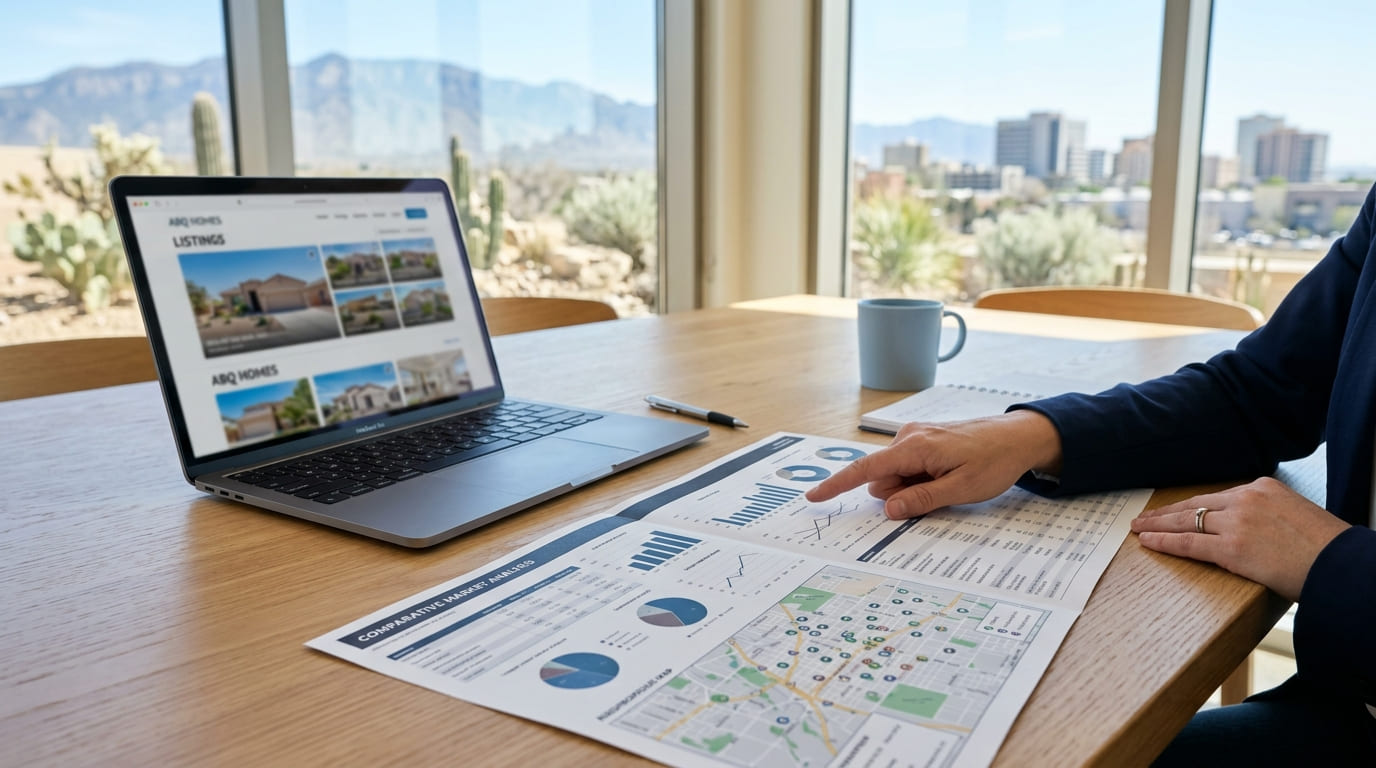
A comparative market analysis, built by a local agent who’s physically seen your home and recent comparable sales, closes the gap an algorithm can’t.
Why a CMA Beats an Algorithm for Figuring Out How Much Your Albuquerque Home Is Worth
A proper CMA pulls recently closed sales, active competition, and pending listings specific to your neighborhood, then adjusts for your home’s actual condition and upgrades, not just its square footage and lot size. It’s the difference between a rough estimate built from incomplete public data and a number built specifically around your property, and in a non-disclosure state like New Mexico, that gap matters more than it would somewhere else.
Frequently Asked Questions About Home Values in Albuquerque
They can be a reasonable ballpark, but Zillow’s own published error rates, roughly 2% for on-market homes and around 7% for off-market homes nationally, tend to run even less reliable in New Mexico due to the state’s non-disclosure property laws.
New Mexico is one of a number of non-disclosure states where actual sale prices aren’t automatically entered into public records, a policy intended to protect buyer and seller privacy during real estate transactions.
A comparative market analysis, or CMA, is a detailed home valuation built by a real estate agent using recent comparable sales, active listings, and your home’s specific condition and features, rather than relying solely on public data and algorithms.
Nationally, Zillow’s own data shows off-market home estimates can differ from actual sale prices by roughly 7% on average, which translates to tens of thousands of dollars on a typical Albuquerque home.
No. An appraisal is a formal, licensed valuation typically required by a lender during a purchase or refinance, while a CMA is a real estate agent’s market-based estimate, usually provided free to help sellers price a home accurately.
Most real estate agents, including ours, provide a comparative market analysis at no cost as a standard part of helping homeowners understand what their property could sell for.
Home values shift with local market conditions, interest rates, and neighborhood-level demand, so it’s reasonable to get an updated estimate every year or two, or any time you’re considering selling.
The Bottom Line
Answering “how much is my Albuquerque home worth” with real confidence means going beyond an algorithm that’s working with incomplete New Mexico sales data in the first place. Online tools are a fine starting point for curiosity, but a real number, one you could actually price a listing or plan a sale around, needs eyes on your specific home and neighborhood.
We are Jennifer and Vinay Rodgers with The Rodgers Neighborhood Real Estate Group, powered by Real Broker, LLC. Request a free comparative market analysis and we’ll give you a number built on real, current comps, not an algorithm guessing around New Mexico’s non-disclosure rules. Reach us at 505-514-5356 or 505-417-2733.

Leave a Reply