

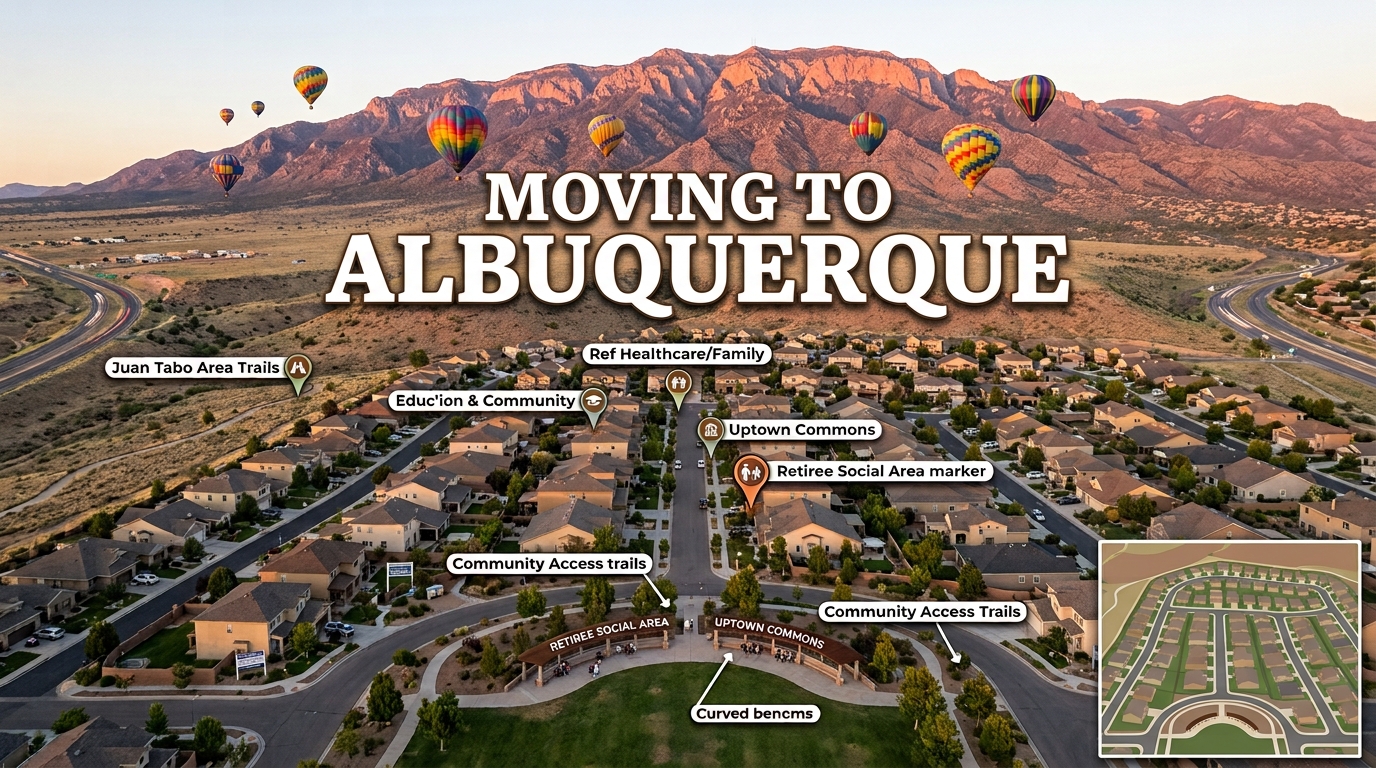
Short answer: for a lot of people, yes, but not for the reasons the top-10 lists usually give you.
We get some version of this question almost weekly, usually from someone who’s never set foot in New Mexico and found us through a Google search at 11 p.m. People considering moving to Albuquerque tend to want a simple yes or no, and the honest answer is more like: it depends what you’re actually optimizing for, and a few things about this city surprise people in both directions.
The Honest Case for Moving to Albuquerque
Start with the obvious one. Housing here is genuinely more affordable than most Western metros, and it’s not just marketing copy, the actual price-per-square-foot math works out better than Denver, Phoenix, or Austin in most comparisons. But affordability only tells half the story, because local wages run below the national median too, so the gap isn’t as dramatic for someone earning an Albuquerque salary as it looks for someone bringing remote income from a coastal city.
The bigger, less obvious draw for a lot of newer arrivals is the economy’s shift. This isn’t the sleepy government-and-university town it was fifteen years ago. Netflix built one of the largest film production campuses in North America here and has continued expanding it, NBCUniversal followed with its own studio investment, and between the two of them there’s been real money and real jobs flowing into the city, not just a few headline announcements.
Where the Trade-Offs Show Up
None of this means Albuquerque is a slam dunk for everyone, and anyone who tells you otherwise is selling something.
Cost of Living: Cheaper, But Not as Simple as the Rankings Suggest
Here’s where it gets messy: different cost-of-living calculators put Albuquerque anywhere from roughly 3% below the national average to a few percent above it, depending on what basket of expenses they’re measuring and how recently their data was pulled. Housing is the one category that’s consistently, meaningfully cheaper. Groceries and utilities usually come in a bit below the national average too. Healthcare tends to run slightly above. According to U.S. Census Bureau data, median household income in Albuquerque still sits below the national figure, so the affordability advantage is real, but it’s not the dramatic bargain some rankings make it sound like.
Jobs and the Film Industry: What It Means for Anyone Moving to Albuquerque for Work
The film production boom is real, and it’s created thousands of jobs across construction, trades, catering, transportation, and production itself, not just on-camera work. But 2026 has brought a genuine slowdown in production volume statewide, and that ripple has hit crew members, small vendors, and businesses that scaled up around the boom. The New Mexico Economic Development Department still points to major long-term studio commitments as a sign of stability, and that’s a fair read too, but if you’re relocating specifically for film work, it’s worth going in with eyes open about the current cycle rather than the peak-hype version of the story.
What This Looks Like If You’re Relocating for a Specific Job
If your move depends on one industry landing you work quickly, do the extra homework: talk to people currently working in that field here, not just the press releases. Healthcare, education, government, and the national labs remain steadier bets than production work if you need predictable income from day one.

Safety and Reputation vs. Day-to-Day Reality
Albuquerque has a reputation, fair or not, for higher crime than a lot of comparably sized cities, and it comes up in nearly every relocation conversation we have. We’re not going to pretend that reputation came from nowhere. What we will say is that it varies enormously block by block, and the neighborhoods most buyers actually end up touring, the Northeast Heights, most of Rio Rancho, the East Mountains, don’t match the parts of the reputation that scare people off. This is genuinely one of the areas where a local guide matters more than a national ranking, since a website can’t tell you which specific streets feel different from the statistics for that zip code.
Weather, Pace of Life, and What the Rankings Don’t Capture
On the upside, the climate genuinely delivers, dry air, real seasons without brutal humidity, and enough sunshine that outdoor plans rarely get cancelled. The pace is slower than a coastal city, which some people love and others find themselves fighting against for the first year. If you’re coming from a place with robust public transit, know upfront that a car is not optional here, the sprawl and the lack of transit infrastructure mean you’ll be driving more than you probably expect.
Frequently Asked Questions About Moving to Albuquerque
Generally yes, particularly on housing, though the size of the advantage depends on which cost-of-living calculator you’re looking at and how it weighs local wages against expenses.
Safety varies significantly by neighborhood, and Albuquerque’s citywide reputation doesn’t always reflect the experience in the areas most relocating families actually settle in. It’s worth researching specific neighborhoods rather than relying on citywide statistics alone
The industry has slowed from its recent peak, so it’s worth confirming actual current demand in your specific role before relocating, rather than assuming the boom-era hiring pace still applies.
Yes, practically speaking. Public transit exists but is limited, and the city’s sprawl means most daily errands and commutes require a vehicle.
Most newcomers point to two things: the crime reputation, which is more nuanced than it sounds at the neighborhood level, and the car-dependent layout, which surprises people coming from more walkable or transit-friendly cities.
The climate and the pace of life tend to surprise people the most, in a good way. Reliable sunshine, mild seasons, and a slower daily rhythm are easy to undervalue until you’re actually living with them.
Healthcare, education, government, and research tied to the national laboratories and Kirtland Air Force Base make up a steadier core of the local job market than the more cyclical film production industry.
The Bottom Line
Moving to Albuquerque is a good call for a lot of people, but it’s a better decision when you go in with real numbers instead of a top-10 list’s headline. Affordable housing and a genuinely growing economy are real advantages. A car-dependent layout and a crime reputation that needs local context are real trade-offs. Neither cancels the other out, they’re just both true. We are Jennifer and Vinay Rodgers with The Rodgers Neighborhood Real Estate Group, powered by Real Broker, LLC. If you’re weighing a move here, our local Albuquerque real estate experts can walk you through specific neighborhoods rather than citywide averages, and our Albuquerque neighborhoods worth touring page is a solid starting point once you’re ready to look. Reach us at 505-514-5356 or 505-417-2733.

Leave a Reply