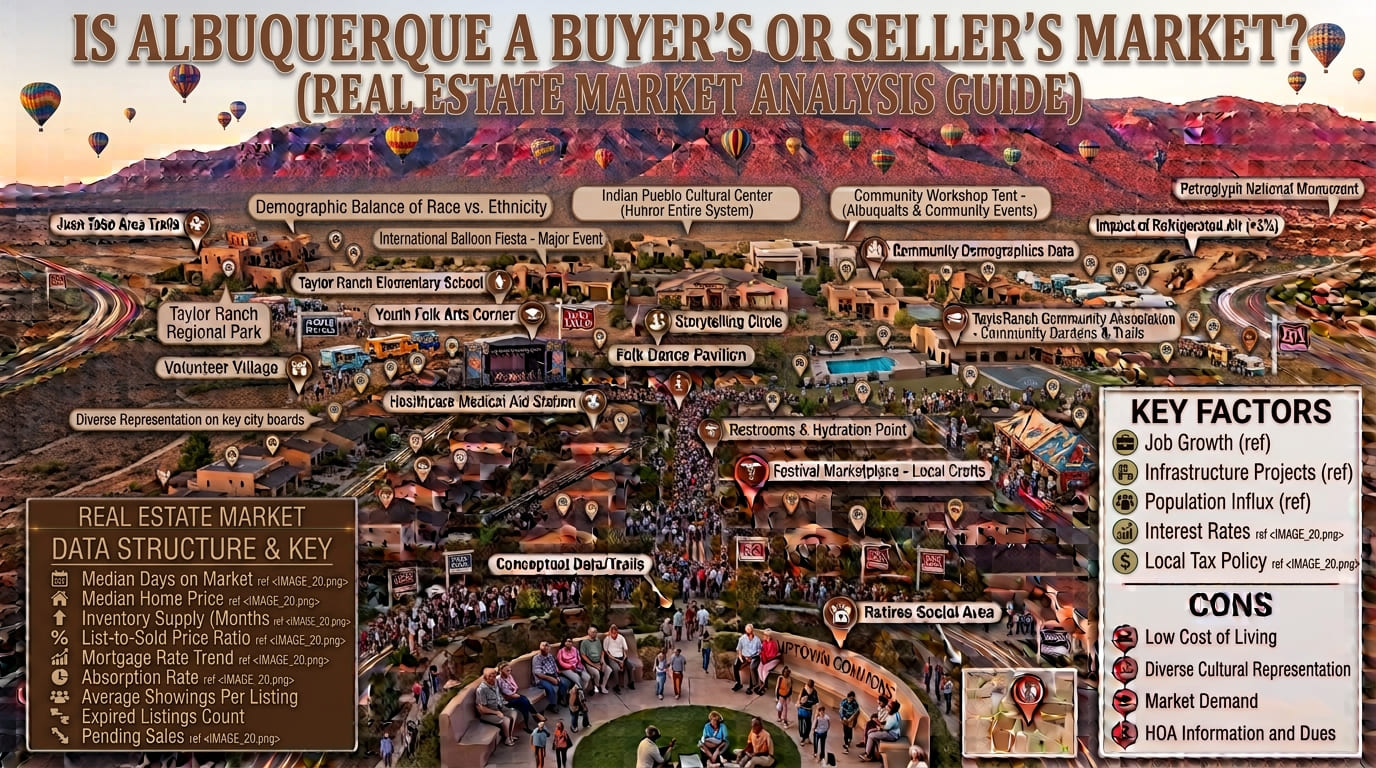
By the industry’s own definition, it’s a seller’s market, with roughly 2.1 to 2.4 months of housing supply against a 4-to-6-month benchmark for “balanced.”
But that one-word answer flattens a market that’s genuinely more nuanced than it was a few years ago. Inventory has been climbing, buyers have real negotiating room in some price bands, and this isn’t the bidding-war frenzy of 2021. It’s a seller’s market with an asterisk.
So, Is Albuquerque a Buyer’s or Seller’s Market Today?
Recent monthly data puts Albuquerque’s median sales price around $385,000 to $386,000, up roughly 3.5% to 4.3% year-over-year, according to figures aligned with Greater Albuquerque Association of REALTORS® reporting, with homes typically going under contract in around 13 days. Steady price growth and fast-moving listings both point in the same direction: sellers still hold the edge, even if it’s a milder one than in past years.
The One Number That Actually Answers This Question
Forget vibes and headlines. There’s an actual industry-standard metric built specifically to answer this.
What Months of Supply Means in Plain English
Months of supply estimates how long it would take to sell every home currently listed if no new listings came onto the market at all, based on the current pace of sales. Under 4 months is generally considered a seller’s market, 4 to 6 months is balanced, and anything above 6 months tips toward buyers.
Where Albuquerque Falls on That Scale Right Now
Albuquerque has been running somewhere around 2.1 to 2.4 months of supply for detached homes through most of 2026, well under the 4-month seller’s market threshold, let alone the 6-month balanced mark. That’s the clearest, least debatable evidence that this remains a seller’s market overall.
Why This Isn’t the Same Seller’s Market as 2021
Active listings have actually climbed noticeably compared to a year or two ago, and buyers in some price bands are negotiating real concessions, closing costs, repair credits, occasionally a few percent off list price, something that was nearly unheard of during the market’s most competitive stretch. Tight supply and a genuinely more negotiable market can, and currently do, coexist.

It’s Not One Market, It’s Several
A single citywide months-of-supply number hides real variation underneath it. Starter homes and mid-range properties are still moving fast with limited inventory, while some higher-end price bands, roughly $400,000 to $550,000 in recent data, have accumulated enough listings to push supply closer to 5 to 6 months, genuinely balanced territory, even while the overall market stays tight. Rio Rancho has continued outpacing the broader metro in appreciation, while other submarkets move at a noticeably slower pace. Our neighborhood-level market data breaks conditions down by area rather than relying on one citywide average.
What This Means Depending on Which Side You’re On
Mortgage rates are also part of this equation. The 30-year fixed rate has been hovering around 6.7%, per the Freddie Mac Primary Mortgage Market Survey, keeping monthly payments elevated even as home prices climb only moderately. For sellers, that combination still generally favors pricing confidently, especially below the median. For buyers, it means real homes are gettable, especially in higher-inventory price bands, but it still rewards being pre-approved and ready to move when the right listing appears.
Is Albuquerque a Buyer’s or Seller’s Market for Your Specific Price Range?
The honest answer depends more on your specific price point and neighborhood than on the citywide headline. A $320,000 starter home in a competitive school zone and a $500,000 move-up property on the edge of the metro are, practically speaking, operating in two different markets right now, even though they’re both technically “in Albuquerque.”
Frequently Asked Questions About Albuquerque’s Buyer’s vs. Seller’s Market Status
Yes, by the standard months-of-supply measure. Albuquerque has been running around 2.1 to 2.4 months of inventory for detached homes, well under the 4-month threshold that typically defines a seller’s market
It’s an estimate of how long current inventory would last at the current sales pace if no new listings came on the market, a standard tool for gauging whether conditions favor buyers or sellers.
No. While supply remains tight overall, inventory has risen compared to recent years, and buyers in some price bands are negotiating real concessions, a meaningful shift from the bidding-war conditions of 2021.
No. Lower and mid-range homes tend to move quickly with limited inventory, while some higher price bands have accumulated enough listings to approach a more balanced market.
With 30-year mortgage rates near 6.7%, elevated monthly payments have tempered some buyer demand even as prices rise, contributing to the more moderate pace seen in 2026 compared to previous years.
Rio Rancho has continued to show some of the metro’s strongest year-over-year appreciation and shortest average days on market, indicating a particularly strong seller’s position in that submarket.
The Bottom Line
Is Albuquerque a buyer’s or seller’s market? By the numbers, it’s still a seller’s market citywide, but a meaningfully calmer, more negotiable one than a few years ago, and the real answer depends heavily on your specific price range and neighborhood. Treat any single citywide label as a starting point, not the full picture.
We are Jennifer and Vinay Rodgers with The Rodgers Neighborhood Real Estate Group, powered by Real Broker, LLC. Whether you’re buying or selling, schedule a consultation with our agents for a read on your specific price range and neighborhood, not just the citywide average. Reach us at 505-514-5356 or 505-417-2733.

Leave a Reply