
This is the guide we wish every relocating client had before their first call with us.
An Albuquerque relocation guide worth reading needs to cover more than “here are five fun facts about green chile.” It needs real numbers on cost of living, an honest look at schools and healthcare, a sense of which neighborhoods actually fit your situation, and a clear path through financing. We’ve written detailed, sourced breakdowns of nearly every piece of this on our blog already, this guide’s job is to organize all of it into one place and point you toward whichever section actually matters for your move. If you want the short version first, our honest look at moving to Albuquerque covers the big trade-offs in about five minutes.
Step 1: Know What You’re Actually Budgeting For
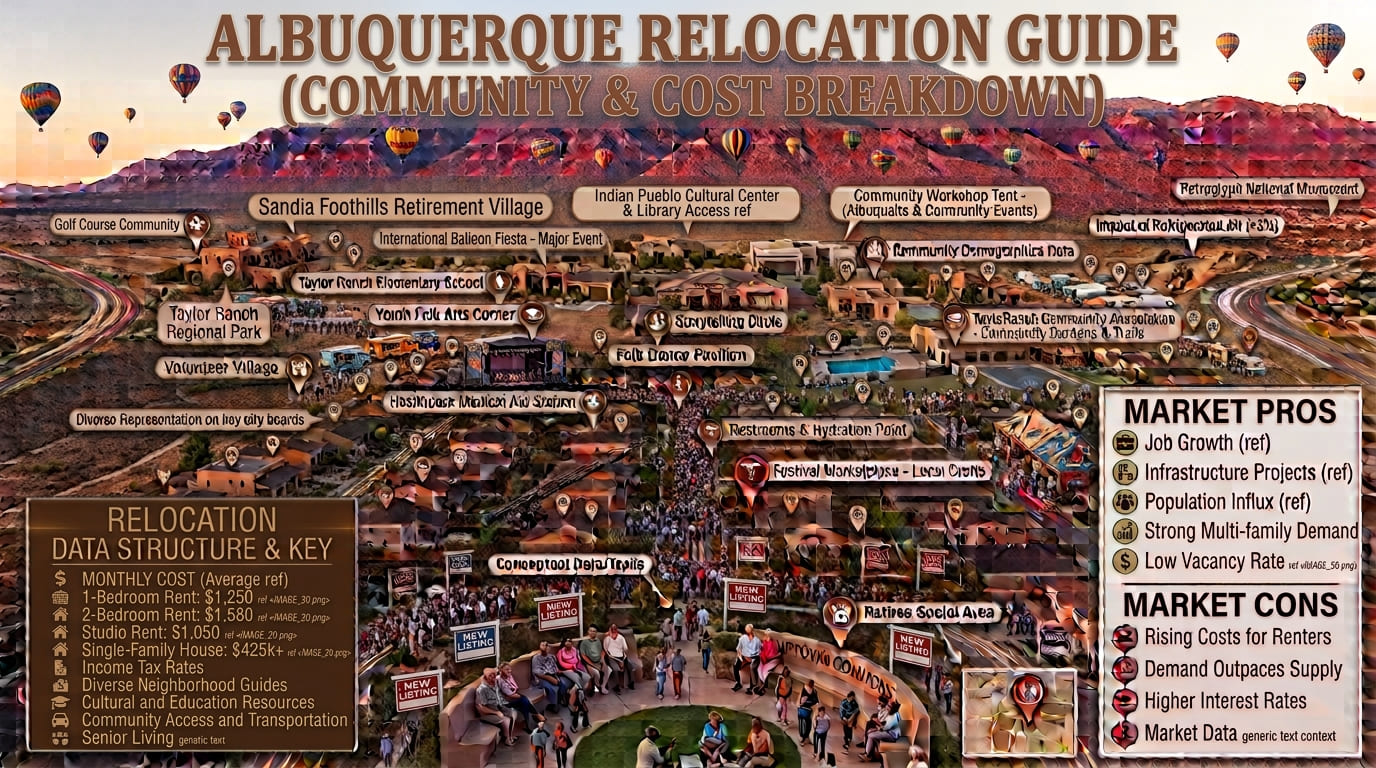
Before you fall in love with a neighborhood, get honest with the numbers. Our breakdown of what salary you need to live comfortably in Albuquerque walks through real, sourced figures rather than the wildly conflicting numbers you’ll find floating around online, and our look at Albuquerque’s average home price and average rent across the metro gives you both sides of the rent-versus-buy decision. According to U.S. Census Bureau data, Albuquerque’s cost of living and median income both run below the national figures, so comparisons to a coastal city’s numbers won’t translate directly, budget off local data, not your current city’s.
Step 2: Choose the Right Part of the Metro
This is where most relocation guides get lazy and just say “it depends on your priorities” without giving you anything to actually compare.
For Families Who Want Space, Schools, and a Newer Home
Families often gravitate toward Rio Rancho for its own school district and newer construction, or toward Albuquerque’s Northeast Heights for established neighborhoods close to some of the district’s stronger schools. Our full rundown of Albuquerque’s best public schools explains why a single district-wide number doesn’t tell the whole story, and why it’s worth confirming your exact zoned school before you commit to a street.
For Buyers Who Want Land, History, or a Slower Pace
If space and character matter more than proximity, our guides to Corrales, Los Ranchos, the North Valley, and Placitas cover the metro’s historic, large-lot communities in detail. For buyers drawn to mountain living specifically, we’ve written separately about Cedar Crest, Sandia Park, Tijeras, and Edgewood out in the East Mountains.
For City Energy and Walkability
If you want restaurants, nightlife, and a genuinely walkable stretch of the city, Nob Hill is worth a close look, along with Taylor Ranch on the West Side if you want mesa views with a shorter commute than the East Mountains offer. Our broader Albuquerque neighborhoods overview is the best jumping-off point if you haven’t narrowed things down yet.
Step 3: Handle the Professional Side of the Move
If you’re relocating for a specific job, where you live should follow your employer, not the other way around. We’ve written a dedicated breakdown for healthcare professionals moving to Albuquerque that maps neighborhoods to specific hospital systems. For film and production industry workers, or anyone curious what’s actually driving the local job market beyond the obvious, our look at moving to Albuquerque for work covers the industry’s real current state, boom and slowdown both. According to the New Mexico Economic Development Department, healthcare, research tied to the national laboratories, and education remain the steadiest parts of the local economy if your move isn’t tied to one specific employer yet.
Step 4: Handle the Financial and Logistical Side
If this is your first home purchase, don’t skip our full rundown of first-time homebuyer programs in Albuquerque, eligible buyers can realistically combine up to $35,000 in down payment assistance, and most people relocating from out of state have never heard of the programs available here. Our general guide to buying a house in Albuquerque covers the rest of the process step by step, from pre-approval through closing.
What This Albuquerque Relocation Guide Covers for Families Specifically
Beyond schools and neighborhoods, families relocating here often ask about healthcare access and everyday life. Our healthcare in Albuquerque overview covers the three major hospital systems and where they’re located, and our honest pros and cons of living in Albuquerque post covers the less glamorous details, like spring wind season and the altitude adjustment, that most guides skip entirely.
Frequently Asked Questions About Relocating to Albuquerque
Start with realistic cost-of-living numbers for your specific household, then narrow down neighborhoods based on your job location, school priorities, or lifestyle preferences rather than starting with neighborhoods first.
Once you’ve found a home, closing typically takes about 30 days from an accepted offer. The search process before that varies widely depending on your criteria and how competitive your target neighborhood is.
Many remote workers relocate here specifically for the lower cost of living relative to coastal cities, though it’s worth confirming your income comfortably clears local affordability benchmarks rather than assuming a lower cost of living automatically means more disposable income.
Yes, for almost everyone. Public transit is limited, and the city’s sprawl means most daily errands and commutes require a vehicle, regardless of which neighborhood you choose.
It depends on how familiar you are with the metro’s different neighborhoods. If you’re relocating sight unseen, a short-term rental in your target area before committing to a purchase can help confirm the fit.
Closing costs (typically 2% to 5% of the purchase price), any HOA fees in planned communities, and the cost of adjusting a home to New Mexico’s climate, like updated landscaping or cooling systems, are commonly underestimated.
The Bottom Line
A real Albuquerque relocation guide isn’t one article, it’s a budget you trust, a neighborhood shortlist that actually fits your life, a clear read on schools or healthcare if those matter to you, and a financing plan that accounts for every dollar of assistance you might qualify for. We’ve built the detailed version of every piece of that on this blog specifically so you don’t have to piece it together from national sites that have never set foot here. We are Jennifer and Vinay Rodgers with The Rodgers Neighborhood Real Estate Group, powered by Real Broker, LLC. With 12+ years of experience helping families and professionals relocate to Albuquerque, Rio Rancho, and the surrounding communities, we’re glad to walk through your specific situation directly. Reach out to start planning your move or call us at 505-514-5356 or 505-417-2733.

Leave a Reply